
Note: I wrote this paper during my first-year of college, while I was enrolled in Yale’s Directed Studies program. I wanted to share it unedited because, as I look back on my academic journey and intellectual growth, I come to the realization that I have traveled a long, long way in my quest for knowledge. Also, I use ‘individual’, ‘Self’, and ‘man’ interchangeably. Man is employed in this short piece as a neutral term without any preference for one sex or gender, and to allow for smooth transition and coherence between sentences and paragraphs.
The concept of “double consciousness” is preeminent in the works of Hegel, Marx, and Du Bois. All three thinkers use the dialectical method to show this doubling in consciousness. Their use of the dialectic allows them to show that the doubling or “two-ness” aims at a reconciliation, a sort of unity that brings about a singularity. This singularity is the Self or the individual, but which does not negate the Other. Hegel uses the notion of “Aufhebung” to show that within the dialectical movement of opposed concepts or determinations, there is canceling, preserving, and overcoming. Thus, in the end, both the thesis, which we may posit as the Self, and the antithesis, the other, are reconciled into the synthesis. In other words, the Self and the Other are united or synthesized into a “double consciousness”.
Though Hegel, Marx, and Du Bois are all dialecticians, their conceptualizations of two consciousnesses are fundamentally different: Hegelian double consciousness focuses on two individuals, that is between one consciousness and another consciousness; in Marx, consciousness involves two opposing classes, the proletariat and the bourgeoisie; and in Du Bois, double consciousness is a one-sided phenomenon that occurs within a single subject or race, the Black individual or the Black race.
Hegel claims that the individual is self-conscious. By self-consciousness, Hegel means that the individual subject is an “I” punctuated by speech. But before the individual achieves self-consciousness, he is first an undifferentiated “I”. Man becomes differentiated the moment he recognizes himself and his desires or emotions or passions. But it seems man’s desires cannot be achieved internally; the objects of desires can be satisfied only in the world, that is, the world of objects. Thus, man as self-consciousness begins a quest for satisfaction and recognition. His satisfaction will come about when he is recognized by another Self-consciousness, another person, or the Other. Man desires to be “acknowledged” by another. The struggle for recognition is essentially a struggle to the death. When two consciousnesses meet, which is quintessentially the meeting of self-consciousness with itself, they engage in a conflict. This conflict is such that the Self seeks the death of the Other. But this conflict must end, however. One man, self-consciousness, disengages from this conflict or struggle for recognition. He withdraws because of his fear of death or his love of life. As self-consciousness, man does not want to die. In other words, he thinks he has been recognized or has recognized the other. Thus, man emerges from this struggle for recognition as either a lord or a bondsman.
Man, by recognizing another Self-consciousness, agrees to become a slave or bondsman. This is the point of Hegel’s master-slave dialectic. But, according to Hegel, the bondsman or slave is the one who is truly free. His freedom consists in his recognition of the Other or in his own work. He works for the master or lord, but it is through his work, through his labor, that he reaches his true self, his true identity, which only comes about because reason tells him to stay alive. Therefore, the slave is simply the rational man. He knows himself, and through his labor, he affirms the facticity of human existence. (The claim to “true self” is what Du Bois will later adopt; Du Bois’ “double consciousness” is, thus, a neo-Hegelianism).
Now, let’s turn to Karl Marx. Marx disagrees with Hegel’s master-slave dialectic. Marx seems to think that Hegel is justifying slavery or the objectification of the individual. He agrees with Hegel that man must work because it is a fact of human existence. The empirical man can only satisfy his desires by working on nature or land, but his work must not turn him into a slave for another man. His work must be about and for himself. Moreover, Marx recognizes that man is a needing being. Man relies on external things (very Hegelian) to satisfy his needs. But man cannot do all by himself for the simple fact that it is impossible to provide everything for oneself; he needs others. Thus, Marx claims that man is a social or species being. But as a social being, Marx says, man can only realize his human capacities when he acts toward or is acted upon by other men or human beings.
These other men are not masters; they are equal members of the same class as the individual man. The class in question is the proletariat. The proletariat is essentially a class of workers, wage earners, who must sell their labor to the bourgeoisie. The bourgeoisie is then, in Marx’s conception, the class of masters. It maintains the old feudal mode of lord and bondsman, or patrician and plebeian. Further, the bourgeoisie exploits the labor of the proletariat; the bourgeois gets “surplus-value”, that is, he continues to get wealthier while the proletarian languishes in poverty and hardship. The proletarian becomes absorbed in his labor, producing things which he never owns. As a result, he is alienated from the products of his labor. However, Marx suggests that the proletariat must become aware or conscious of his exploitation and alienation, and take decisive action, even violent revolutionary action. The proletarian must not withdraw into “infinite resignation” (to use Kierkegaard); he must be conscious of his class and the opposing class. Thus, Marx claims, man must engage in a struggle. His struggle must be for freedom from slavery, that is, exploitation. Only when the proletariat class has united will there be true and total freedom. Where does Du Bois stand in all this?
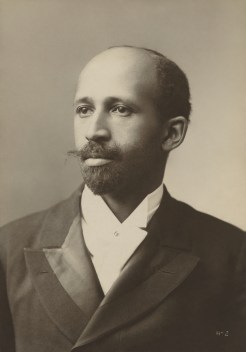
It would not be a mistake to claim that Du Bois embodies both Hegel and Marx. Although the two focus their critiques of society on individuals and classes respectively, Du Bois’ critique is situated within the context of race. Du Bois is aware that man is an individual who is a member of a class. But he knows that to understand man requires an understanding of his race. After all, slavery and struggles for freedom have largely been based on racial differences for much of history. Like Hegel and Marx, he, too, is operating in historical modes. Hegel claims that history is but a struggle between two individuals or Self-consciousnesses; Marx says that the struggle has been between two classes; and Du Bois adds that it is between two races: the Negro and the Caucasian.
But Du Bois’ concern is not to demonstrate this struggle of races, because either race is conscious of said struggle. Rather, he wants to show that within the consciousness of that struggle, there is “double consciousness”. Double consciousness is a phenomenon that only the (American) Negro knows. The Negro is aware that he lives within a social duality. He knows that he exists in a social stratum in which the White race has the material advantage, that is, the white individual possesses all the wealth. The Negro recognizes his poverty and hardship, and knows that he is kept impoverished conditions, in which he is enslaved and treated as a slave, an object in the “American world”, which is certainly white America. White America is engaged in a deliberate scheme to keep him in his condition. But Du Bois suggests that the Negro knows this all too well. The Negro recognizes that there is the Other (the White man); thus, the Negro begins to act according to what the Other expects of him. He conforms to the stereotypes that have been allotted him.
Yet, Du Bois claims that it is precisely this double consciousness that enables the Negro to reach his “truer and better self”. One may ask: How does recognizing the oppressor, enslaver, or master lead the Negro to his true and better self? It seems Du Bois’ argument is not for the Negro to accept his suffering. The recognition of the Other, the White race, is rather a gesture on the part of Du Bois to argue and establish the humanity inherent within the American Negro. The American Negro recognizes that he belongs, first and foremost, in his own race (other negroes like himself). Next, he realizes that he lives in a world in which there are others, i.e., other races. This awareness (or double consciousness) allows the Negro to treat the other — white America to be specific — with boundless loving kind. Despite his oppression and dehumanization, the Negro desires to live in a world with the white people. All the Negro seeks is the liberation of his race. He wants the Other to treat him with dignity and respect and equality. The Negro strife or struggle for recognition is not a struggle to kill the other or to use violence means. His struggle for satisfaction, freedom, and recognition is a struggle to attain his true self, to exert his meaning in the world. Although Du Bois differs from Hegel and Marx in the way he conceptualizes this struggle, yet, like both, his theory of “double consciousness” affirms how individuals, classes, or races are engaged in a strife for self-assertion or self- affirmation. Thus, Du Bois is both a Hegelian and a Marxist, or a Hegelian-Marxist.
 Abraham M. Keita