
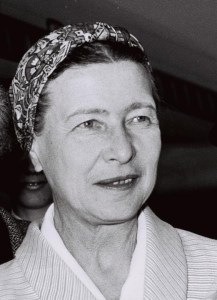
Simone de Beauvoir (French, 1908-1986) is a philosopher of freedom. She thinks that man is free and ought to be free. When he acts, his actions must be unconstrained by any abstract moral rule – as Kant suggests – because abstract rules do not help in particular situations. Every particular situation has its own set of rules of action which the individual must discover by himself. Hence, the meaning of a situation, a thing, or an object is determined by man alone. His freedom allows him to put value in things or objects. She writes: “Value is this lacking-being of which freedom makes itself a lack; and it is because the latter makes itself a lack that value appears”. This means that there is no inherent value in an object or activity; value originates from the human individual.
Man gives value to things. When man acts, he adds value to his actions, and thus, to the things which are the objects of his actions. Action is value-oriented; it is the act of valuing. People have projects and the value of their projects are given by themselves. For example, it is workers who add value to the products of their labor; the products themselves do not have inherent values (De Beauvoir knew her Marx well).
Because freedom is a fact of human existence, de Beauvoir thinks freedom is an external thing, i.e., it can only be realized through an outer expression or project. To the extent that my freedom acts outwardly, my freedom realizes itself in a world of others, and hence, the freedom of others is presupposed. Thus, one must recognize and acknowledge the freedom of another person.
But people are always trying to deny the freedom of others. How would de Beauvoir respond? Let’s consider an example. I work in the textile industry with a company called XYZ Incorporated. I have been in its employ for nearly a decade. Like other workers, I took up the job for subsistence and to avoid being drafted into the military, since it was during the war period. When I was offered the job, the company was at the verge of extinction due to bankruptcy. But with time, it became one of the most successful and financially-stable companies in the world, with the managers and board members rising into the wealthiest class. On the other hand, ordinary workers of XYZ continue to languish in poverty, with their living conditions never changing at all. When I started working, we were promised that we would start receiving a monthly salary once the war was over. Although the war has been over for about 5 years now, the company has never kept its end of the bargain.
Workers like me strive daily, and whether you are a janitor, or an operator of machines (power loom and cotton gin), or a receptionist, you have never received a penny in wages. Every time workers voice their concern, the company makes the same old promise. But one day, we decided to make a collective stand, to protest against the economic injustice and oppression we have long faced: few in the company are getting richer, while the workers – on whose shoulders the company’s success depends – continue to work and live in harsh conditions, with little, and in most cases, no pay.
We deliberate our course of actions. Some suggest that we keep on appealing to the company’s management, in the hope that they will see a reason to create better working conditions and pay workers their just wages. Others insist that they have been ignored and oppressed for too long, so the time for dialogue is over, and therefore, workers must organize a series of protests that would bring an end to the injustices. As we deliberate on how to proceed, de Beauvoir walks in.
She sides with those who want to protest. According to her, freedom realizes itself only by engaging itself in the world, a simple fact of human existence. Man’s project toward freedom is embodied in definite acts of behavior. Thus, freedom is action, or as noted above, it is a valuing-action. By choosing to protest, the workers would be exercising their freedom, their freedom to end injustice or oppression. For de Beauvoir, those who deny the freedom of others, like the company’s managers refusing to pay workers’ wages, are engaging in an act of oppression.
Oppression occurs when some people use their freedom to take away the freedom of others. It denies man the chance to justify his own life through acts that create oneself by transcending his current being, his current state. Workers are oppressed by employers when they are condemned to mark time in order to support the employers or masters. The masters in turn prioritize workers’ leisure as a way for the laborers to regain their strength to continue working. Thus, de Beauvoir says, “a freedom which is interested only in denying freedom must be denied”. In other words, oppression must be met with resistance. The workers who want to protest will be doing just this.
But one might respond to de Beauvoir that if oppression must be resisted, then it is more likely than not that violence will ensue. The employers, frightened by the workers, will take all measures to ensure their security, and protect their properties. They wouldn’t allow workers to access the company’s vicinity. On the other hand, the workers will continue to insist that their demands be met. The end result will be a clash between two opposing sides, a clash which will eventually lead to mayhem and destruction.
De Beauvoir would perhaps respond that violence is inevitable, and that if the workers indeed want to exercise their freedom and be freed from the trap of economic injustice, then they must engage in violence themselves. She thinks that the oppressors or employers would never readily give the workers their freedom or end the economic injustice, and those who think that the employers would willingly do so simply believe in what she calls “utopian reverie”. But she thinks that any violence by the workers must be justified, that is, it must be for the sake of freedom, equality or liberation. Hence, the workers must only engage in violence when the employers resort to “absolute evil”, i.e., when freedom is completely denied and attempts to be free oppressed through violence. In other words, violence must resist violence.
But if violence is to be justified by some evil, de Beauvoir has to tell us how we come to know that something is evil or absolutely evil and what characterizes this evil; and, at what point should the workers resist their oppressors. But it seems she has no definition of what evil or absolute evil is. Even so, the premise of her argument still holds true: the oppressors never voluntarily free the oppressed, freedom must be demanded by the oppressed.
 Abraham M. Keita