
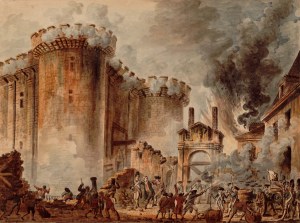
 (It is Bastille Day – July 14, 2023 – the day that commemorates the French Revolution. On July 14, 1789, revolutionary elements stormed the Bastille, a symbol of dogmatic authority and political repression in the then Ancien Regime under King Louis XVI. This event is thought to have fully ushered in a new world, the modern world, where individual freedom, liberty and equality were to become the new social and political creed. In other words, Bastille Day is a celebration of the day when the new world broke away and emerged from old. The person whose political doctrines had the greatest influence on the French Revolution and its leaders was the political philosopher Jean-Jacques Rousseau. The following piece is a sketch and an interpretation of his political thought).
What is the state of modern or civil society? Could there be something distinctive about this state as opposed to the natural state? Is man free and whole in the modern state or modern civil society? To help us understand these pressing questions about political life, we turn to Jean-Jacques Rousseau. For Rousseau, there are two problems with civil or political society: First, civil society makes an illegitimate claim to better the lives of individuals; it is illegitimate because it enchains the individual and makes him a slave to other individuals. Second, this enslavement comes about because civil society’s most defining character trait, and the modern individual’s unique passion, is amour-propre, or vanity. Then, ee suggest that for Rousseau, amour-propre or vanity has both a negative and a positive feature, and that the latter is the inverse of the former.
Rousseau is a man of paradoxes and contraries or opposites. (This will be more clearly shown when we turn to the positive and negative aspects of amour-propre). In fact, Rousseau could only interpret or tell us what amour-propre itself is by considering it along its opposite or contrary, amour de soi. Some have said that Rousseau is an anti-rationalist and a rationalist. He is anti-rationalist given his criticism of the Enlightenment, or “Age of Reason”, in the entirety of the First Discourse, as well as in the Second Discourse, where speaking of natural man he writes, “Regardless of what the Moralists may say about it, human understanding owes much to the Passions […] It is by their activity that reason perfects itself; We seek to know only because we desire to enjoy, and it is not possible why someone who had neither desires nor fears would take the trouble to reason” (SD, pp. 142). As opposed to other Enlightenment philosophers and thinkers, who prioritize reason over passion as the mechanism of knowledge, Rousseau suggests that knowledge begins with the human passions, by which he means the human desire to know is a reflexive act, a turning inward, and any action done for the sake of oneself must provide some enjoyment or satisfaction. Thus, like David Hume – who considers himself an anti-rationalist and insists that “reason is and ought to be the slave of the passions” – Rousseau suggests that we can only ever know the individual if we know his passions or desires; his passions are what allow his faculty of reason to be perfected.
But Rousseau is also a rationalist, and his influence on the philosophical project of rationalism is so enormous, especially by way of Kant – the dean of the Enlightenment project and who gives it its post decisive meaning in “An Answer to the Question: What is Enlightenment?”. So influential was Rousseau on Kant that the latter calls him the Newton of the moral universe. Moreover, when Rousseau speaks of the “faculty of perfectibility” in natural man’s transition from the state of nature to civil society, he might be speaking of reason in its embryonic stage, and which becomes fully cultivated and takes the name “faculty of reason” – as used by Kant and the rationalists – in modern times. Thus, for Rousseau, reason turns out to be a marker of modern civil society. Even more, throughout Rousseau’s writings, one cannot fail to recognize his pairing of opposites: authentic and inauthentic, sincere and insincere, real self and alienated self, and inward and outward.
Although we are constantly confronted with Rousseauian paradoxes, Rousseau’s writings on the state of modern culture and civil society lack any such charge of being contradictory or paradoxical. He is a staunch critic of civil society in contradistinction to the natural state; which is to say, Rousseau prefers the natural man to the civil. Rousseau’s views on civil society may be full of ambiguities, but he does not hesitate to call out the problems that bedevil modern civil society. Right at the beginning of the Social Contract, Rousseau writes: “Man is born free, and everywhere he is in chains. One believes himself the others’ master, and yet is more a slave than they. How did this change come about? I do not know. What can make it legitimate? I believe I can solve this question” (Book One, chp. I, pp. 41). These words are perhaps Rousseau’s most scathing critique and indictment of modern society. For Rousseau, the advance to civil society from the state of nature – though a proof of the human’s ability to perfect oneself, i.e., “the faculty of perfectibility” – is man’s self-imprisonment. (Note: Our use of “man” means the human individual, taken as encompassing all genders and sexes, although for Rousseau’s context, it seems he has in mind, man qua man).
In the state of nature, man is free and independent, and his needs are easily satisfied. The individual has the simple “sentiment of existence”, that is, he desires to live each passing day as it comes and goes. What he desires is mere comfort and contentment; he seeks nothing that is excessive; he has no sense of pride, honor, glory or recognition. But in civil society, the individual desires all these things, he craves them, and he goes to any lengths to get them. Thus, we can say that the civil man is more or like a multiplicity of desires, and he is a slave to these desires and whoever helps him satisfy them. This then is the first problem Rousseau identifies in civil society: its tendency to increase man’s appetites; its preoccupation with the conditions of happiness without being concerned with happiness itself. In short, the attitude of man in civil society becomes extremely selfish and transactional. It is a transaction because whenever the individual acts alone or within a group, his self-interest or self-preservation is invariably what he desires to satisfy. On this note, we turn to the second problem – vanity, or properly speaking, amour-propre – which fully explicates the first problem we just now outlined briefly.
Up to this point, we have been suggesting that Rousseau is a critic of modern civil society as such. Let us now qualify, or modify, this view. What Rousseau really criticizes about modern civil society is the individualistic superstructure it establishes and maintains. This focus on the individual is based on the sentiment or character trait – amour propre – that is harnessed and honed in modern man due to the state of modern civil society. Often left in the French, amour propre seems to refer to a number of psychological states or characteristics, like vanity, pride, conceit, perhaps even a subtle egocentrism. For Rousseau, amour propre is a vestige of modern society, and it only arises in such society. If there exist discontents in modern society, and they most certainly do, then they are caused by amour-propre or vanity.
In a lengthy passage in his footnotes in the Second Discourse, Rousseau distinguishes amour propre from its opposite, amour de soi: “Amour propre [vanity] and Amour de soi-même [self-love], two very different passions in their nature and their effects, should not be confused. Self-love is a natural sentiment which inclines every animal to attend to its self-preservation and which, guided in many by reason and modified by pity, produces humanity and virtue. Amour propre is only a relative sentiment, factitious, and born in society, which inclines every individual to set greater store by himself than by anyone else, inspires men with all the evils they do one another, and is the genuine source of honor” (Note XV [1], pp. 218). We will say more about this distinction, but for now, let us say more about amour-propre.
Certain questions immediately come to mind: How did this passion or sentiment (vanity) arise? What conditioned its coming into existence in modern man or society? And since Rousseau tells us in the Social Contract that he can solve the problem of modern civil society, a third question would be, what can we do to address it? Writing about two centuries before Rousseau, Thomas Hobbes suggests that pride or vanity, in other words the tendency and desire to be superior, is a natural condition of the human individual. It is natural because no one wants to be dominated; instead, it is a natural desire to want to dominate others. For Hobbes, this pride, vanity or desire is the cause of “the war of all against all” in the natural state, and it is one which man brings with him into civil society. Hobbes, therefore, suggests that civil society or the sovereign comes into being in order to curtail and contain this desire to dominate others. But Rousseau disagrees. He argues that vanity or pride could only come about after the state of nature. According to Hobbes, the natural state is asocial and deeply solitary and brutish. Rousseau, thus, insists that if the state of nature is solitary and asocial, it is incoherent to say that the individual man has pride or vanity, because this would presuppose social existence or social relations. Thus, like Marx who turned Hegel on his head, Rousseau uses Hobbes’s account to make his own case, i.e., that amour propre is not a natural sentiment and that it could only come about once individuals enter society. It follows then that amour propre is relative and artificial, and could possibly be diminished. But Rousseau does not suggest this, perhaps because he sees in amour propre both a negative and positive effect, perhaps because it longer can be uprooted from human life.
One only needs to take a step back to consider the rise of amour propre – right when the state of nature was passing into obscurity and giving way to modern society – bearing in mind that for Rousseau this is speculative or hypothetical history of man. Amour propre or vanity began to shape up into a modern maker when individuals started gathering around a tree or a hut, and thus looking at each other. Rousseau goes at length: “Everyone began to look at everyone else and to wish to be looked at himself, and public esteem acquired a price. The one who sang or danced best; the handsomest, the strongest, the most skillful, or the most eloquent came to be the most highly regarded, and this was the first step at once toward inequality and vice: from these first preferences arose vanity and contempt on the one hand, shame and envy on the other; and the fermentation caused by these new leavens eventually produced compounds fatal to happiness and innocence” (¶16, pp. 166). It is no surprise, then, that in Rousseau’s account of the state of nature, there is a total, even natural, absence of vanity – that strong emotional string that leads to murderous conflicts. This suggests why Rousseau claims that he has demonstrated that the human individual possesses a certain natural goodness because he harms no one in the state of nature, and hence, this natural goodness is pure because he has no inkling of virtue or morality (pp. 161; 187-88).
Vanity, thus, is the individual’s complete absorption into himself. He is absorbed into himself not in the sense that he is removed from the world and people around. Instead, he focuses on his own private interests, needs, and wellbeing. If he mingles with others, it is because he sees them as a catalyst to his self-preservation. Whatever he does alone, he does for himself, and whatever he does with others he does so for his own personal gratification. This is the contradictory condition of modern society: modern or civil man is independent, while simultaneously he is dependent on others. When he works or collaborates with others, whether by force or reason, he thinks only of himself, that is, his ends. For him, people are the means to his ends; they are never ends in themselves. Finally, the modern man is both a master and a slave: he is master because all his actions originate from him, but he is enslaved or enchained because he is forced to work or collaborate with others, even when he does not want to, just so he can attain his end, i.e., self-preservation. This seems to be why Rousseau suggests that man is in chains in civil society.
So far, we have been discussing amour propre in terms of its negative feature. But it also has an inverse characteristic that is positive, something essential to political life. Earlier, Rousseau talked about people gathering around a hut or tree to look at one another. In the quote we cited, Rousseau paints an eloquent picture of human societies as they transitioned into modern times.
In those societies, perhaps even in our own time today, children and adults would gather around a fire, in the town square, as individuals take turns telling folktales and stories, many of which make up their own oral history. These storytellers often demand the undivided attention of their listeners, calling out those who create disturbance. Put another way, each speaker or storyteller desires to be recognized and adhered to when it is her turn to address those who have gathered. It follows that the desire for recognition – to be heard, listened to, and taken seriously – is at the crux of and is the positive feature of amour propre in modern society. Once individuals enter into society, they feel a desire, as if naturally, to be recognized or respected by others around them. As humans, we want our beliefs, opinions, feelings, skills, and talents to be acknowledged or recognized. We become uneasy, angry, when they are not.
On a side note, the desire for recognition is a theme that would later be picked up by Hegel in all his writings, and made more eminent by his famous master-slave dialectic in the second chapter of the Phenomenology of Spirit. The desire to be recognized is at the core of justice in political life itself. The foundation of political life – that is, the foundation of the city, state, city-state, nation, nation-state, in short, the foundation of every political and civic community – begins with the question, what is justice? Going back to Plato’s Republic, the problem of the nature of the just city or the just citizen is the object of political philosophy. Every political philosophizing seeks to answer the question what is just, which by extension means, what is good, what is equality, or what is freedom.
In conclusion, as we mentioned earlier, there is a distinction between amour-propre and amour de soi as Rousseau states explicitly: one is vanity, the other is self-love. The reason for this distinction, we think, is to explain the tension within modern man, to show why he is no longer whole, why he is no longer his true self. Both imply amour-propre and amour de soi mean a certain kind of self-love or the love of oneself. As Pierre Manent claims in the chapter on Rousseau in An Intellectual History of Liberalism, pp. 64-79, self-love as vanity (amour-propre) does not mean genuinely loving oneself (amour de soi). Self-love or vanity is merely comparing oneself to others, the desire to be held in high esteem as one esteems oneself. But the modern individual knows that his self-love or vanity cannot be completely satisfied. Conscious of this, he begins to despise others for their own vanity. Thus, the individual lives in a modern society in which he lives for the gaze and acknowledgment of others, while at the same time he hates them.
Works Cited
1. Rousseau. The Discourses and Other Early Political Writings: edited by Victor Gourevitch. Cambridge Texts in the History of Political Thought, 1997.
2. Rousseau. The Social Contract and Other Later Political Writings: edited by Victor Gourevitch. Cambridge Texts in the History of Political Thought, 1997.
 Abraham M. Keita