
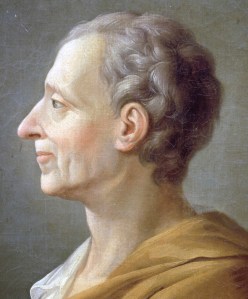
 Like classical and medieval political philosophers and thinkers, Charles de Montesquieu does provide an account of political regime. Unlike them, he does not classify regimes based on the intentions or passions of the rulers. Put another way, Montesquieu has no theory of virtue versus vice. According to the ‘ancients’ or classical tradition, a good regime is one geared towards the common good, taken essentially as the political good; and, a bad regime is one which serves the interest and advantage of the ruler. For Montesquieu, to properly understand political regime or rule, we must turn to an examination of its laws. He writes: “Law must relate to the nature and the principle of the government that is established or that one wants to establish, whether those laws form it as political laws, or maintain it, as do civil laws” (The Spirit of the Laws). In other words, every government or political regime can best be understood in terms of its laws, for it is in the laws that we can determine its nature and principle.
The nature of a government is that which makes it what it is, that is, its essence, its internal or rather implicit makeup; whereas its principle is what drives it, what moves it to action. Thus, in posing and answering the question as to the importance of determining what a government’s nature and principle are and their relation to political rule, Montesquieu seems to be suggesting that one comes to know its nature if one knows who rules and how she or he rules, and its principle is simply the passions that put it in motion. Montesquieu classifies governments or political regimes into three: republic, monarchy, and despotism. Let’s take one of these – monarchy – to examine what Montesquieu has to say about its nature and principle.
Before doing so, we ought to point out that in investigating regimes or political rule based on a specific set of laws, laws which must be related to a nation’s physical outlook and social conditions, Montesquieu leaves open his teaching to the charge of relativism. But this relativism is not subjective relativism (subjectivism), it is not the mundane relativism which is fashionable and prevalent in modern society. Montesquieuian relativism is taken with a view that the laws of nations are formulated and can best be grasped or comprehended within the context of particular historical circumstances.
Yet, Montesquieu seems to admit that historical events as such can be adequately studied against the backdrop of a totality or chain of general causes: “Many of the truths will make themselves felt here only when one sees the chain connecting them with others.” Hence, Montesquieu insists that principles which he discusses in the Spirit of the Laws should be seen as drawn from the “nature of things”, thus giving these principles a universal status, albeit, exemplified or instantiated by particular circumstances. Thus, whether one studies republicanism in antiquity or in modern times, one finds that the its nature (whether democratic and aristocratic) is, as Montesquieu puts it, “that the people as a body, or certain families, have the sovereign power.” If we observe features of Athenian democracy and American democracy, we will find that though both may be unique to their own particular epoch and circumstances, nonetheless, each retains a universal character or nature, i.e., as a popular government or government of the people.
So much for this observation. Attention must now be given to the nature and principle of monarchy. Montesquieu immediately points out at the beginning of Book III that “the laws should be no less relative to the principle of each government than to its nature. Therefore, this principle must be sought.” What this implies is that it is much more a difficult task to determine the principle of monarch – or of the other two forms of government – than its nature. The nature of monarchical government is this: one person (“prince”) governs according to fixed and established laws. But because monarchies rule people as their subjects, this demands that there be an intermediate or mediating power or body. The nobility or clergy occupies this role, however, without any design, plan or intention.
The principle of monarchy is honor, not virtue as in the case of republic. Montesquieu begins by providing a stinging criticism of monarchy’s subjects, writing that “in a monarchy it is very difficult for the people to be virtuous.” Similarly, he is severely critical of the courts and the “wretched character of the courtiers” in monarchy. Monarchy is characterized by idle ambition, meanness, arrogance, the lust for wealth without work, a distaste for truth, and many other pitfalls. Even so, Montesquieu insists that the desire for honor is the most important (positive) feature of monarchies. Honor is the “prejudice of each person and each condition.” In other words, honor is the superiority of the person and his or her condition. Since political virtue understood as such is impossible, or as we noted, since it is difficult for the people to be virtuous, honor thus becomes the incentive or substitute in monarchy as opposed to virtue proper in republic. Virtuous action is replaced by honorable deed. The prince, the nobility, the clergy – they all desire honor but it is a selfish kind of honor, it is honor which is oriented towards the interest and good of the self or individual.
This type of honor and the desire for it is formed and driven by ambition. As Montesquieu writes: “Ambition is pernicious in a republic. It has good effects in monarchy; it gives life to that government; and it has this advantage, that it is not dangerous because it can constantly be repressed.” Every one, every class in a monarchy is possessed by ambitious goals, thus ambition becomes a springboard for acquiring distinction. It follows that honor seems to have a dual character: a positive and negative aspect. The positive aspect of honor is that it makes individuals and social classes ambitious, thereby serving as the basis for good conduct and which hence is for the public benefit: “Honor makes all the parts of the body politic move; its very action binds them, and each person works for the common good, believing he works for his individual interests.” Positive honor is “false honor” as Montesquieu puts it.
Yet, honor also has a negative aspect: its motive is essentially private and it aims towards the good of the individual or class alone. Paradoxically, this is true honor. He says “false honor is as useful to the public as the true one would be to the individuals who could have it.” For Montesquieu then, true honor is essentially espoused or demonstrated by individuals. If honor is a virtue, it would be a selfish kind of virtue. Notice also that there is an inversion here: Montesquieu criticizes monarchical government for its negative characteristic, yet this is essentially the true version of honor that individual seeks. He extols the positive version because it brings about some public benefit, although it is false honor, a mere pretense.
Lingering Questions:
- How is honor different from virtue? Are all virtuous actions honorable while not all honorable actions are virtuous?
- Is Montesquieu’s definition of honor sufficient? If not, does this tell us anything about his discussion of monarchy?
- Assuming that the principle of each government or regime is unique only to itself, should we then say that there is no honor in republican government? Is virtue then the only principle we find in both democratic and aristocratic republicanism?
 Abraham M. Keita