
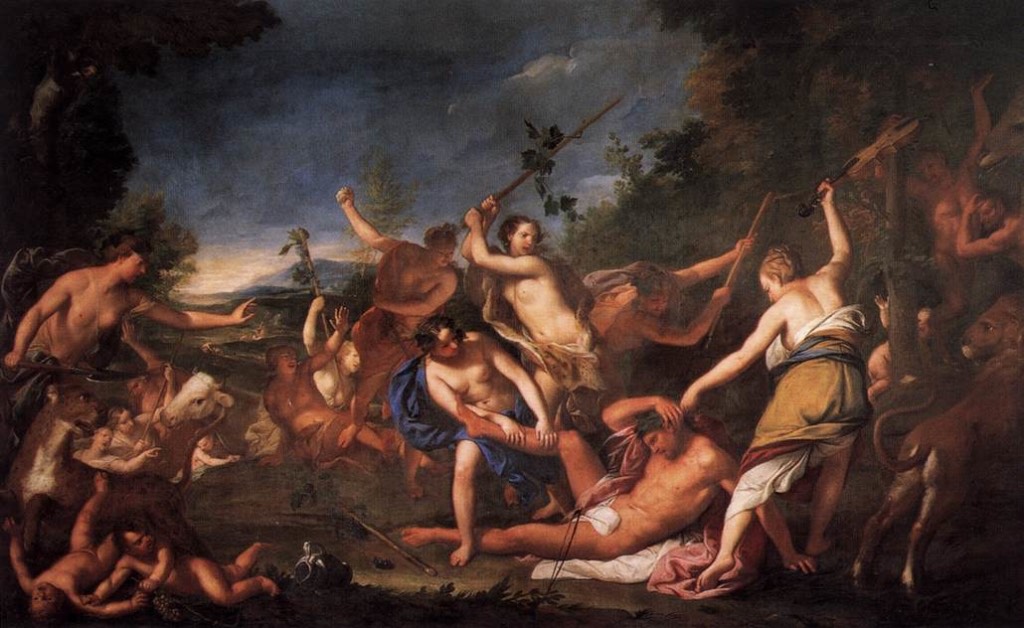
Euripides’ Bacchae is no doubt a play of contradictions, or oppositions. As a whole, it aims at – to put it in Fichtean terms – the synthesis of a thesis and an antithesis. But this synthesis is more about striking a balance between opposite things or ideas than it is about superseding their differences. Balance, it seems, is the main theme of the Bacchae (1022-27). The Greek god Dionysos seeks to strike a balance between the rational and irrational, order and disorder, naturel (physis) and the convention (nomos). Yet, the attainment of balance seems to be an almost impossible, even improbable venture, for the simple fact that opposites always try to undo one another. It is common sense that a thing or concept tries to annihilate and replace what it considers opposed to itself; what is opposed tries to take the place of what opposes. Thus, an attempt to seek balance inevitably leads to imbalance, unity to further disunity. This Dionysian quest for balance is the eminent undoing of political life. In the Bacchae, both the city and the individual are reduced to nothing. Civilization dies, the foundation of the city-state is destroyed, and the citizen qua individual loses their sense of identity, thereby leading to doom.
Euripides begins his play with the arrival of Dionysos, the Greek god of wine, festivity, and theater. In the Prologue, Dionysos declares: “I, son of Zeus, have come to Theban soil…[home] Of Semele, my mother…Having changed my shape from god to mortal.” Euripides hints at Dionysos’ quest for balance in the opening lines. Dionysos tells the audience that he is the son of a god as well as child to a human mother. His simultaneous nature as mortal and immortal raises the question of identity, for he must either choose and stay a god or man. His insistence on being both is what brings about the destruction of the city. As I will demonstrate shortly, this identity crisis all the more cements the impossibility of Dionysian balance in Thebes.
Does Dionysos seek the city’s best interest? Dionysos adds in the Prologue: “So, like a gadfly I have stung these sisters / To a frenzy, out of their homes, to live / Crazed in the mountains… I’ve driven [them] from their homes in a state of madness.” Dionysos’ proclamation of himself as a “gadfly” parallels similar assertion in Plato’s Apology, where Socrates refers to himself as a gadfly over Athens. But while Socrates staunchly and stubbornly advocates philosophic truth and the city’s moral life and progress by persistently demanding that Athens embraces reason and justice – things necessary for political life – Dionysos plunges Thebes into chaos. Dionysiac rituals imply a disruption, destruction, dissolution of the city and the norms that it clings unto.
Hence, the chaos Dionysos wrecks occurs as a result of the failure to see reason, or rather, the inability to be rational. As we see, the citizens, particularly the women, are driven into “a state of madness”, a state in which they lose their rational faculty. Dionysos puts Pentheus in a similar state before he is destroyed from limb to limb by the Bacchants, including his own mother: “Let’s take our vengeance on him: first, derange / His mind and put him in a giddy frenzy” (968). Here, then, Euripides seems to suggest that Dionysos is anti-reason; Dionysos epitomizes the irrational.
Reason or rational thought, Plato and Aristotle would suggest, is necessary for political existence. Where reason or logos rules, law or nomos rules. The city establishes laws that govern the lives of the citizens, to bring about a just and happy life. Justice and happiness ought to be the aim of a rational citizenry. Reason or the understanding as such brings about order, since the city that is happy and practices justice is an orderly city. It follows that to be anti-reason is to be anti-order, or to embrace disorder.
Yet, Dionysian or Bakkhic rituals allow citizens to unleash their wildest, even natural, desires through drinking and dancing. The attainment of the objects of one’s desires brings about happiness. Furthermore, since Dionysian rituals take women “out of their homes”, therefore, Dionysos arrival marks the beginning of the dissolution of the patriarchal control that characterizes the city. He brings about the freedom of women; their liberation from the traditional roles imposed on them by the male-dominant society (981-1001).
It follows that with the arrival of Dionysos comes the dismantling of a status quo that prevents women from participating in life outside the household. Although Dionysiac freedom cuts the chain that binds women to the household, it seems such freedom does not end the control exerted over women in the household. Dionysos asserts that the women are “Crazed in the mountains” and “I made them wear / The trappings of their service to me” (46-8) because of “neglect / Of my Bakkhic rituals” (54-5). Dionysos exerts control over the women. He makes them engage in wild dance and unrestrained intoxication. Thus, although his religious rites pull women out of the mere confines of the household and give them happiness, Dionysiac control replaces patriarchal control. Moreover, it seems the women’s happiness is temporary. The bliss of the Bakkhic rituals is soon followed by bloodshed, or dismembering.
The chorus claims Dionysos “will keep the household safe and whole” (465). But this seems to run contrary to the dismembering that occurs towards the end of the play. Pentheus opposes the Bakkhic rituals because he thinks it corrupts the women and goes against the city’s laws and political customs (254-270). Although Pentheus is a tyrant and his response a reflection of the typical male-dominated culture of his day, there is a sense in which his concern about the “new evils” that Dionysos brings is justified. The rituals make the women unleash insane and unrestrained feelings of excitement, engage in wild fulfillment of their desires, and build up uncontrolled anger due to irrational emotions. Pentheus’s mother, Agaue, exemplifies the dangers of Bakkhic rituals. She, blinded and empowered by Dionysos, tears apart her own son; she dismembers Pentheus with her bare hands (1271-80). This suggests that the claim that Dionysos will save and protect the household is false. Dionysos actually destroys the household by turning a mother against her son as well as forcing apart a father, Kadmos, from his daughter, Agaue, in order that each may face their own fate (1600).
Dionysos and his Bakkhic rituals raise the question of identity as I mentioned earlier. These rituals are mired by wildness and intoxication. The women and the Bakkhic dancers alike enter into a state of total madness. They become completely irrational, lose their sense of remorse, and act in ways contrary to their true or normal selves. It follows that one loses oneself. The loss of the self implies that one becomes something other, a not-self. If the Self becomes Other, then it means that Dionysiac freedom, Dionysian balance brings about the loss of one true self, that is, one’s true identity. The city and its citizens are hence confronted with an identity crisis (587-592). This crisis of identity begins the moment Dionysos transforms himself into a mortal. Pentheus does not recognize him: “Where is he, then? My eyes don’t see him here”. Moreover, Pentheus is given different identities by Dionysos: first, by making him dress up like a woman (968-70); and second, by making him appear like a wild animal, a “tree-climbing beast” as Agaue says.
I conclude by noting that the assertion by the chorus which suggests that Dionysos exemplifies the very idea or notion of balance is simply misguided. The chorus claims Dionysos is both the “most terrible” and the “most gentle”. In other words, Dionysos is balance itself. But, as I interpret it, if attaining balance is impossible, if Dionysiac rituals and dance which are supposed to bring about this balance are rejected by Thebes, it implies the rejection of Dionysos himself. Thus, the simple fact that balance is impossible presupposes that Dionysos is rejected long before he ventures to establish his rites in Thebes. Further, since the Bakkhic rituals lead to a mother rising against her son, or blood rising against blood, it seems that Dionysos’ arrival brings about the transcendence of all human relations. Human relationship is the bedrock of political life, and transcending, or rather disregarding it, implies the transcendence or disregard of political life. If political life is transcended, then the city or state cannot exist, because only in the city or state can there be any discussions of politics, that is, of happiness, justice, and freedom. Thus, Dionysos is an opponent of the city or political life, and his arrival marks its undoing.
Work Cited:
Euripides. The Complete Euripides Volume IV: Bacchae and Other Plays. Peter Burian and Alan Shapiro. Oxford University Press, 2009.
 Abraham M. Keita